
FROM INSIDE THE CULTURE, NOT ABOUT IT
Los Tranquilos aren’t chasing the past; they’re living it.
Written By: Sarah Delgado, Contributor
FRESNO, Calif.– As lights dimmed to a red pool at Fulton 55 on Aug. 13, audience members watched lead singer Manny Martinez work the stage in soulful longing. Throughout the performance, fans swayed to the rhythm, feeling the deep bass of “JJ” Martinez’s bass and the beat of Richie Guereca’s drumming as the band launched into “Camina Distinto (Separate Ways).”
As the crowd gathered in the intimate space, nobody looked like they were hearing Los Tranquilos’ music for the first time, even if they were. That’s the strange gravity that this band carries, which blends soul, romantica and rock, into what the Central Coast has continuously claimed as a nostalgic sound.
Los Tranquilos aren’t revivalists; they’re playing the music they grew up on, which echoes older traditional forms. They’re aware their music makes people feel nostalgic, even for eras listeners never lived through.
“We're also trying to push our sound forward... just trying to make it true to ourselves,” Manny Martinez said
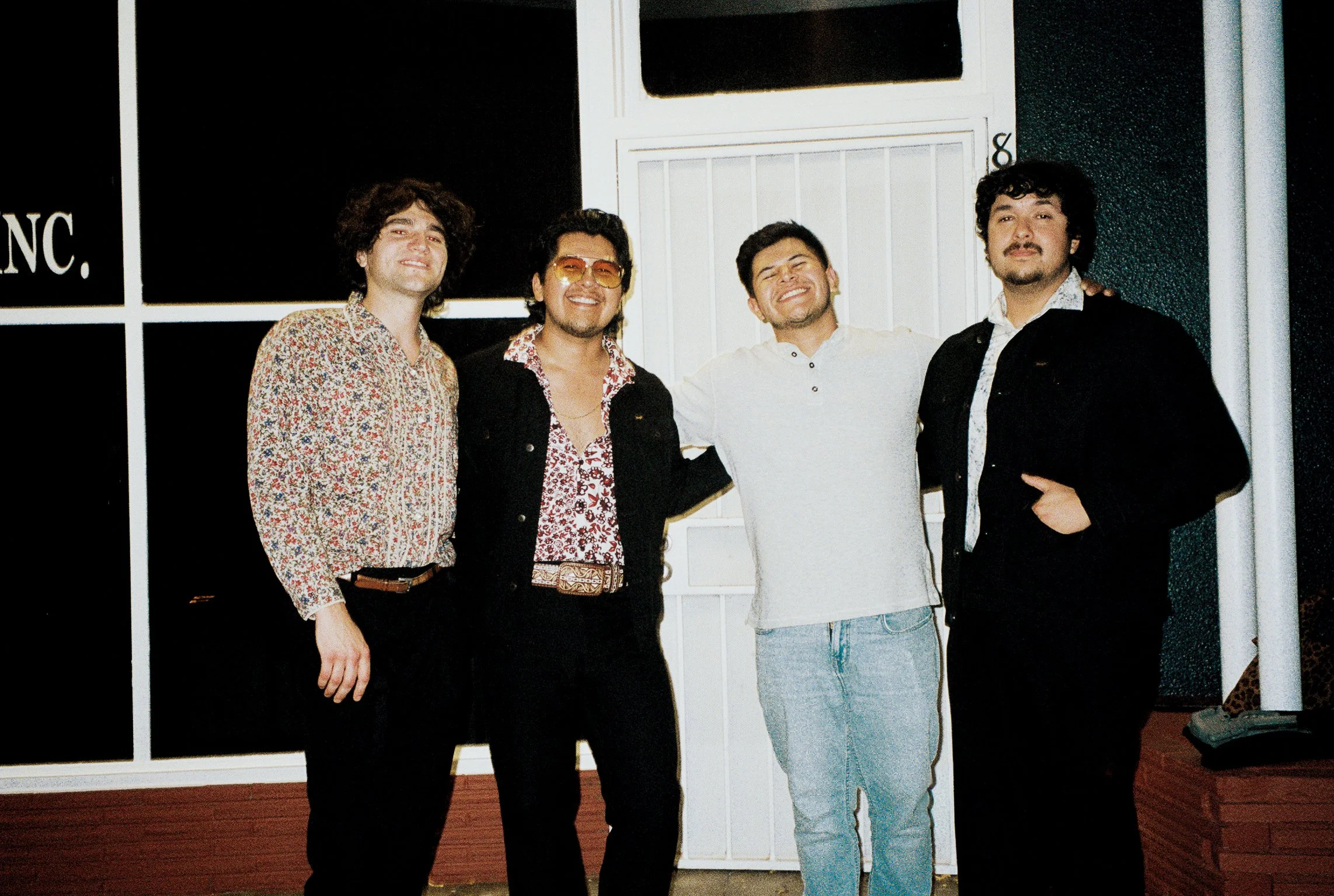
Photo By: Leisa Reyes, EIC
That distinction matters for the band. Critics often reduce their sound to a revival and nostalgia band reaching backward for its aesthetic. Ask the members directly, though, and they describe something closer to an inheritance rather than an imitation.
“We make the music from inside the culture [Chicano and Mexican culture]; we're all like surrounded by it,” Manny Martinez said. “We're all immersed in it, and then the music that we play is a direct manifestation of everything that we grew up listening to.”
The band's trace their roots directly to the Central Coast. The Martinez brothers and guitarist Cameron Porter hail from Nipomo, while drummer Richie Guereca comes from Oxnard. Through mutual friends and some back-up gigs, the band eventually formulated its permanent lineup despite the two-hour distance.
“So we've actually been friends for years in other parts. We've done some backup shows. Particularly, we did one in Santa Maria, which is like right near Nipomo,” Guereca said.
The band’s ties to the Central Coast region show up when they perform, even if they’re playing directly in it. Los Tranquilos singled out Guadalupe Cafe, in Guadalupe, California, crediting the venue as their very first stage.
“There's not a lot of venues [in our hometown] still, but we represent our hometown every show we play, so I'd say that's honestly the biggest part that a band can do is always mention where they're from and be proud of it,” Porter says.
Since Los Tranquilos' music encapsulates what it’s like to be a lover boy raised in California with Mexican roots, the band’s sense of representing rather than explaining extends to how the band thinks about listeners who might be encountering their culture for the first time. Rather than labeling the experience, they let their music do the work on its own.
The same thought appears for the band’s first EP, with artwork incorporating different iconography native to Mexican culture. The centerpiece is an anatomically correct heart composed of butterflies and a jaguar's head, roots, and a traditional Zapotec staircase pattern. The jaguar appears again on stage, as a projection behind Guereca.
“Our visuals and what we present to our audience, and in that album cover, it has a lot of elements that are part of our culture, which is Oaxaca and Michoacan,” Manny Martinez said. “We try to be very intentional with our visuals.”
It’s a fitting extension of how the band portrays itself in everything else: not as a costume but something closer to a language they were already speaking. One that aims to resonate universally.
“Because I could explain it one way, but people interpret things so many different ways,” Manny Martinez said.
During “Teotitlan,” which translates to “land of gods” from Zapotec, the performance transformed the venue into a psychedelic trance. The crowd moves in a fluid snake-line dance to the smooth guitar lines from Porter and Manny Martinez.
“We hope to come to a city near you soon,” Guereca said as the interview wrapped, framing the band’s expansion less as hope and more like inevitability.
